Independent L1 · testnet live

Derivatives, on
first principles.

Perpetuals, spot and options from one account with one margin number. The matching engine and the clearinghouse run inside consensus — final in a single block.

Trade everything in one place

BTC, ETH, SOL and more — perpetuals, spot and options — from a single account, against one margin number.

Trade →
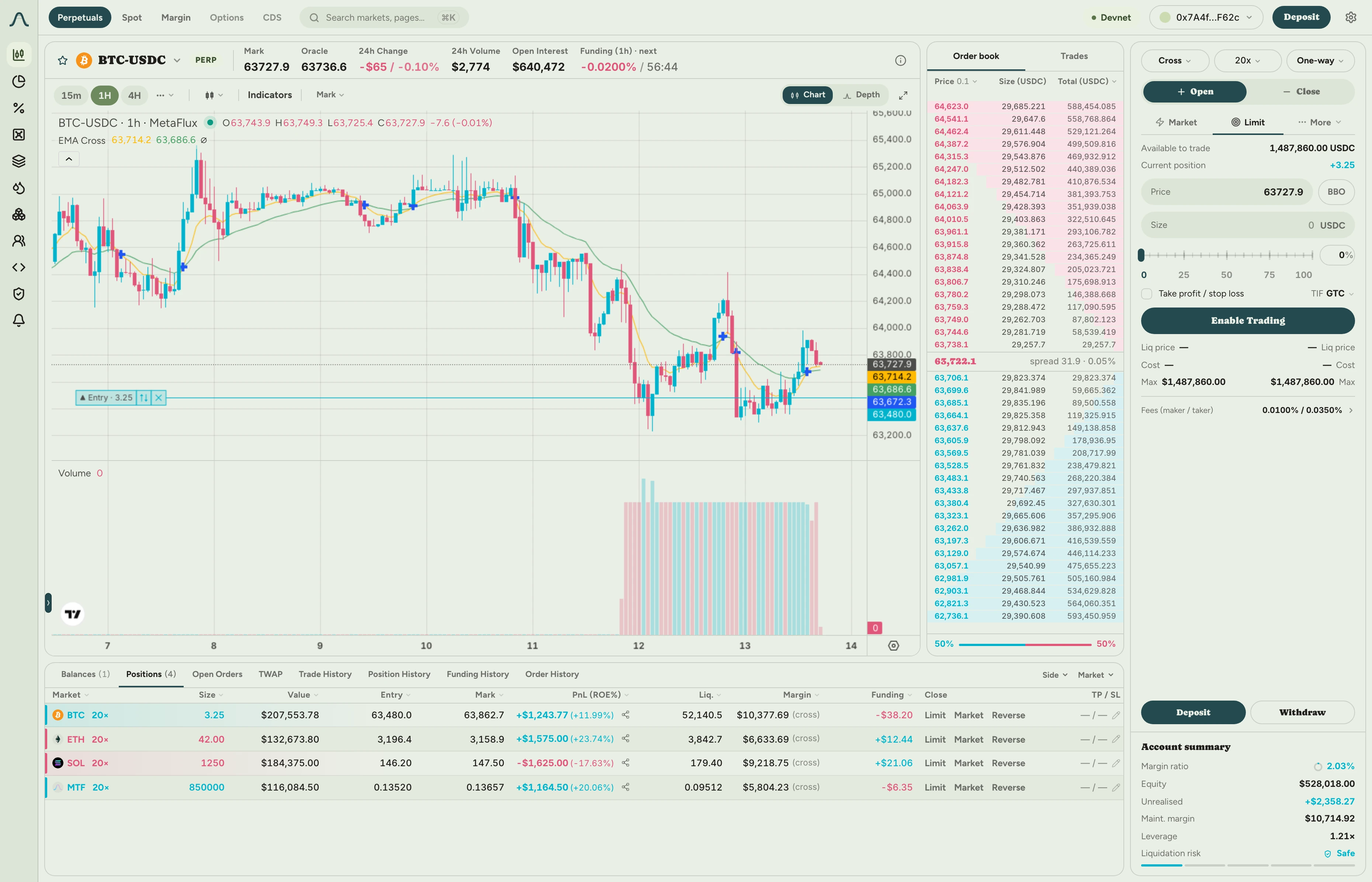
The MetaFlux testnet trading desk: a BTC-USDC perpetual with its candle chart, live order book, order ticket, a four-position blotter and the account summary.
Products

MetaFlux starts from one premise: a derivatives exchange should be a chain, not a contract on one.

When the clearing engine is the state machine, the rules of the market are the rules of the ledger — deterministic, auditable, final in one block.

The EVM shares every block, so strategies, vaults and market listings are programs, not permissions. Anyone can list a market; the winning bid is burned, and nobody is paid to approve you.

Components ship across phased testnet milestones. Where this site describes something not yet live, the whitepaper says when.

Security

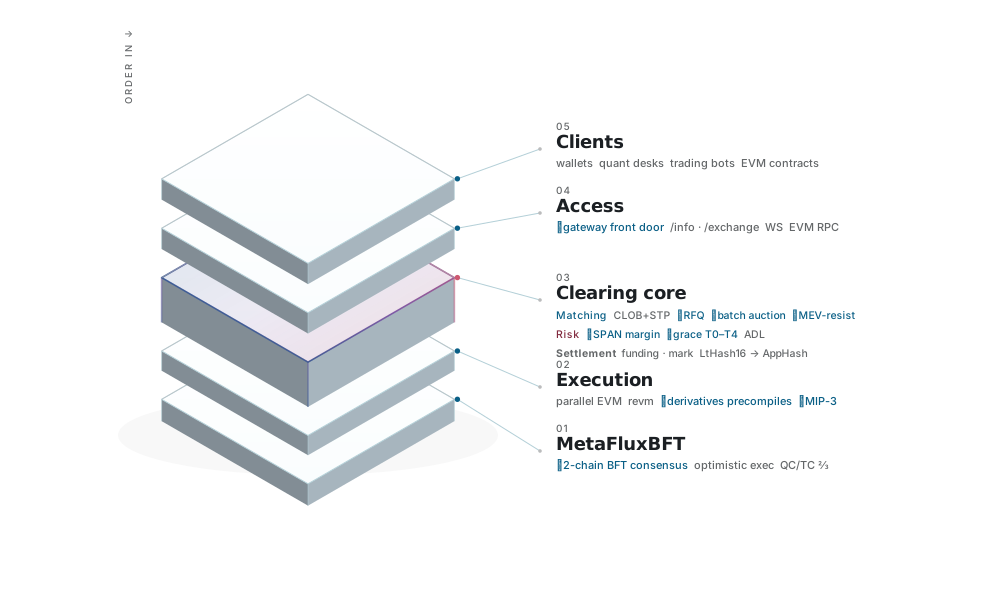
MetaFlux is secured by MetaFluxBFT, a stake-weighted BFT protocol with immediate finality.

A quorum certificate needs two-thirds of bonded stake, so safety holds unconditionally against any adversary below one-third. Leadership rotates every round; a faulty leader costs one round, never the chain. Double-signing is self-evidencing from two conflicting signed votes and slashes 5% of stake. Floating point, unordered iteration and wall-clock reads are prohibited in the consensus path.

MetaFlux architecture: clients, access layer, clearing core, execution, MetaFluxBFT consensus
FAQ
What is MetaFlux, exactly?

An independent L1 derivatives chain. Its own validator set, its own BFT consensus, its own EVM execution layer. Built from first principles for derivatives clearing, not borrowed from a general-purpose L1.

Which parts of this are shipping today?

Components ship across phased testnet milestones — the testnet runs the clearing core, the parallel EVM and the book; the rest lands on the sequence the whitepaper sets out. Where this site describes something that isn't live yet, the whitepaper says when.

When does mainnet launch?

Mainnet follows audit and testnet milestones, not calendar dates. The testnet is live and open for integration now; six months of public testnet precede the TGE, with phased validator onboarding and the bridge audit as the explicit gating item.

What does integration look like?

One gateway serves POST /info, POST /exchange, WebSocket and EVM JSON-RPC. Orders are signed in a standard EIP-712 envelope, so hardware signers and browser wallets work unmodified; agent wallets sign every order and never hold withdrawal authority. The SDKs (TypeScript and Rust, preview) map agent wallets, sub-accounts, vaults, cross and isolated margin and client order ids one to one. Docs →

Who is the testnet for?

Anyone — there is no application and no allow-list. Take test USDC from the faucet, point your client at the gateway, and trade. We especially want to hear from market makers and teams shipping production trading systems: [email protected].